
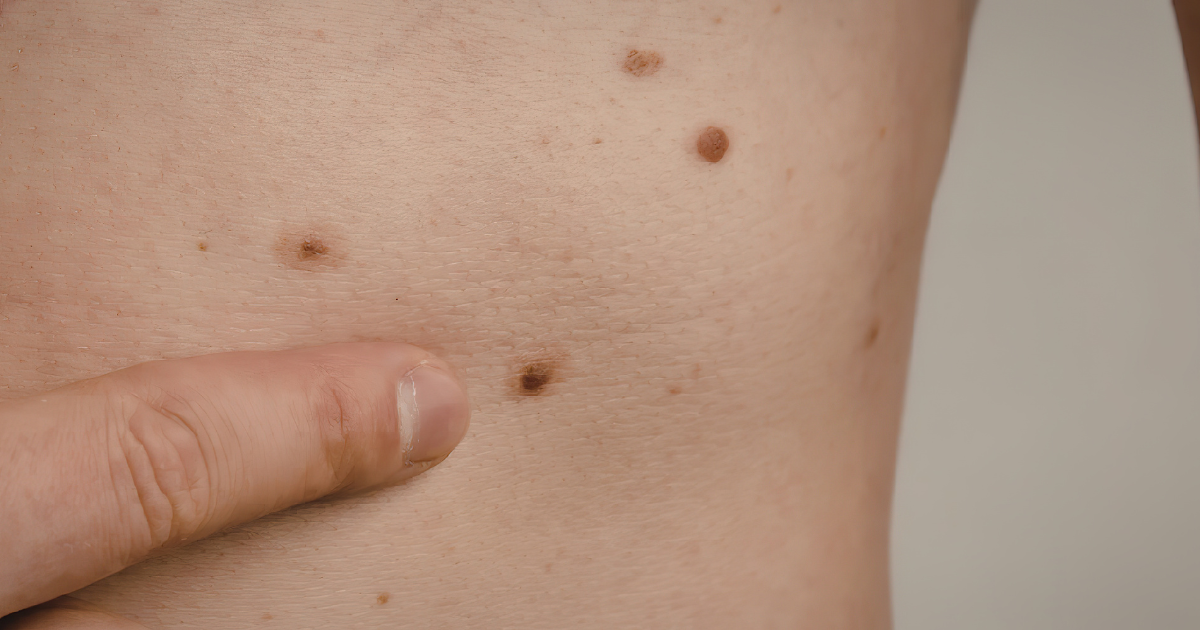
Do you know how to do a self-check on skin at home? Performing self-checks regularly can help ensure that you notice any suspicious spots early. Here’s how to do a self-exam at home, and everything else you need to know.
Why Skin Cancer Self-Exams are Important
Put simply, doing a self-check helps you catch skin cancer spots early. Early detection is the key to treatment success. Regular self-exams are important for everyone, but especially people who are at higher risk of skin cancer.
[Related: Preventing Skin Cancer]
ABCDE Rule
What should you be looking for during a skin check? You are looking for any moles, birthmarks, blemishes, or spots that look suspicious. Most skin cancer does appear in areas that get more sun, but it can occur anywhere on your body.
Not all skin cancer looks the same. It can show up in many shapes and sizes, and it can even look like other non-cancerous skin conditions. A helpful way to know what to look for is the ABCDE rule.
A: Asymmetry- one half of the spot is shaped differently or unlike the other half
B: Border irregularity- the border of the spot is irregular, scalloped, or poorly defined
C: Color variation- the spot changes colors from one area to the next
D: Diameter- a diameter larger than a pencil eraser
E: Evolving- spots that evolve or change (size, shape or color)
How to Perform a Self-Check at Home
First, gather your materials. You need a handheld mirror and a large mirror in a well-lit room. Having a partner or family member help with hard to see areas like your back or scalp is also ideal.
Face the Mirror
Check your face, ears, neck, chest and belly. Don’t forget to lift your breasts to check the underside. Next check both sides of your arms and lift your arms to check underarms. Then, check the palm of your hands and in between your fingernails as well.
Sit Down
Check the front of your thighs, shins, tops of your feet and in between your toes. Then grab your hand mirror to check the bottoms of your feet, calves, and backs of your thighs.
Use the hand mirror to check your genitals, buttocks, lower and upper back, and the back of your neck and ears.
Use a comb to part your hair and check your scalp thoroughly.
When to See a Dermatologist for a Skin Check in Chevy Chase
We recommend seeing a dermatologist at least once a year for a skin cancer screening. However, higher risk patients may need to be seen more often, like every six months. If you notice any new spots on your skin, spots that are unusual, or spots that itch, bleed, or change size or shape, you should schedule an appointment with a skin cancer specialist right away.
Cronin Dermatology specializes in skin cancer treatment, lasers, cosmetic procedures, acne treatment, and anti-aging treatments. Contact us today for a one-on-one consultation!